
When Clinical Conversations Move to WhatsApp: What Changes?
A quiet shift in patient communication is changing the way…
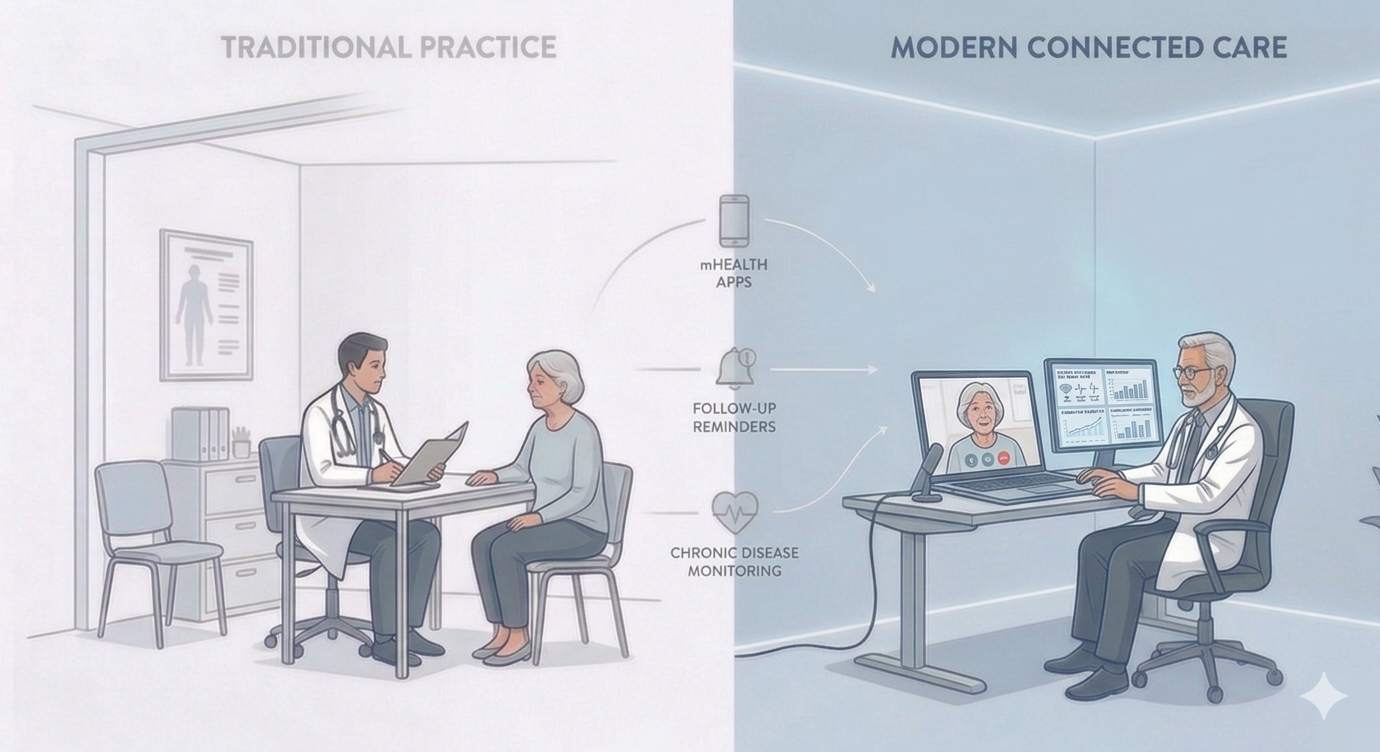
For decades, the traditional medical practice model was straightforward.
A patient falls sick → visits the clinic → receives treatment → leaves → returns only when necessary.
This system worked well for generations. Doctors built strong reputations locally, patient trust grew through word-of-mouth, and clinics operated with predictable patient flow.
However, healthcare has entered a new era.
Digital technology, patient expectations, and evolving healthcare behavior have significantly changed how medical practices function. Clinics that rely solely on the traditional approach are increasingly noticing something concerning:
fewer follow-ups, declining patient retention, and reduced long-term engagement.
Meanwhile, a small group of forward-thinking physicians are thriving.
These doctors—often referred to as the top 1% of modern practitioners—have adapted their practice models to the changing healthcare landscape.
This article explores why the old model of practice is gradually declining and what successful doctors are doing differently to build sustainable, modern medical practices.
Historically, healthcare operated on an episodic care model.
In this system:
While effective for acute illnesses, this model has several limitations in the modern healthcare environment.
Healthcare today increasingly focuses on:
These areas require long-term interaction between doctors and patients, something the traditional model does not naturally support.
Patient behavior today is very different from what it was a decade ago.
Before visiting a doctor, many patients now tend to:
Healthcare, in many ways, has become part of a broader decision-making journey for patients.
As a result, accessibility and ease of interaction are beginning to influence patient choices more than before.
This shift is not about clinical capability.
It reflects how patients are now approaching healthcare decisions in a more informed and convenience-driven manner.
Along with behavior, patient expectations have also gradually changed.
Today, patients are accustomed to convenience in almost every service they use in daily life. Naturally, similar expectations are extending into healthcare as well.
They tend to value:
When this experience feels fragmented or inconsistent, patients may gradually disengage—even if they are satisfied with the medical care received.
This shift is subtle but important.
It highlights that alongside clinical expertise, the overall patient experience and continuity are playing an increasingly important role in how patients stay connected with a practice.
One of the less visible challenges in traditional practice is patient attrition.
Consider a common scenario.
A patient visits the clinic, receives appropriate treatment, and begins to recover. The consultation goes well, and the patient leaves with the intention to follow up if required.
However, as time passes, that connection gradually weakens.
The patient may delay the next visit, feel better temporarily, or simply get occupied with daily life. Without consistent continuity, the treatment journey becomes irregular.
Over time, the patient quietly drifts away.
This does not happen because the medical care was inadequate—it happens because continuity in the patient journey was not sustained.
In many practices, this leads to a gradual but significant drop in long-term patient engagement, often without being immediately noticeable.
Today, a large portion of medical practice involves managing long-term chronic conditions such as diabetes,hypertension,thyroid disorders,heart disease,obesity,mental health conditions and other lifestyle diseases.
These diseases require continuous monitoring, lifestyle adjustments, and regular follow-ups.
A single clinic visit cannot manage these conditions effectively.
Doctors who adopt continuous care models—through digital monitoring, reminders, and structured follow-ups—achieve far better long-term patient outcomes.
While many clinics experience challenges with patient continuity and engagement, a small group of physicians are quietly building highly stable and well-connected practices.
The difference is not in how they practice medicine,
but in how they approach patient relationships and continuity of care.
Tracking blood sugar trends — especially during the prediabetes stage — helps individuals:
Studies have shown that lifestyle interventions during prediabetes can significantly reduce the risk of developing diabetes.
Early correction prevents costly escalation.
As practices grow, managing every aspect manually becomes increasingly challenging.
Some doctors address this by introducing more clarity and structure into how their practice functions day to day.
This helps ensure that:
Without necessarily increasing effort, their work becomes more streamlined and predictable.
In many successful practices, care does not feel limited to the time spent inside the clinic.
There is a stronger sense of continuity—where patients feel guided and supported throughout their treatment process.
This is especially valuable in long-term and lifestyle-related conditions, where consistency plays a key role in outcomes.
Patients today value a sense of connection just as much as clinical care.
Doctors who are able to maintain that connection—before, during, and after consultations—often see stronger trust and engagement from their patients.
Over time, this leads to:
Patients increasingly appreciate doctors who help them navigate and manage their health over time, rather than only addressing concerns at isolated points.
This subtle shift—from episodic care to continuous engagement—is what sets certain practices apart today.

Medicine will always require human expertise, clinical judgment, and patient trust.
Technology cannot replace doctors.
However, technology can enhance how doctors deliver care.
The future belongs to physicians who combine:
clinical excellence + smart digital practice management
These doctors are not just treating illness.
They are building long-term healthcare ecosystems around their patients.
The decline of the traditional medical practice model does not mean medicine itself is changing.
It means how healthcare is delivered is evolving.
Patients now seek:
Doctors who adapt to these expectations will not only maintain successful practices but also create deeper, more meaningful relationships with their patients.
The most successful physicians of the future will not simply run clinics.
They will build connected healthcare systems centered around their patients’ long-term well-being.
A quiet shift in patient communication is changing the way…

For many years, patient loyalty in medical practice was relatively…

For decades, the traditional medical practice model…